
World Cup 2026 Host Cities
A practical guide to the 2026 World Cup host cities, including where matches will be played, how the cities are grouped across three countries, and what fans should think about before planning around a specific location.
On this page
Why host cities matter more than most fans expect
A lot of fans look at a World Cup and think in teams first. That makes sense. People naturally focus on the country they support, the players they want to watch, and the matches they do not want to miss. But for a tournament as large and spread out as the 2026 World Cup, host cities matter almost as much as the teams.
This is not just because the matches happen there. It is because the city often determines the real shape of the fan experience. Your kickoff time, your travel route, your hotel choices, your rest days, your backup match options, and even how stressful the trip feels can all change depending on the city you build around.
In a smaller tournament, fans can sometimes treat cities as a detail. In this edition, that approach is risky. The 2026 World Cup is the largest World Cup yet, with 48 teams and 104 matches. It is also the first men’s World Cup to be hosted by three nations at once. That means the host city map is not background information. It is part of the planning logic itself.
A good host cities page should therefore do more than list places. It should help fans make better decisions. If you want a flagship match, your city strategy will look one way. If you want to watch multiple games without overcomplicating your trip, it may look completely different. If you are chasing atmosphere over headline matchups, that can also change the answer.
That is the purpose of this page. It is not just here to repeat the host city names. It is here to help you understand what those city choices actually mean.
How the host map works in 2026
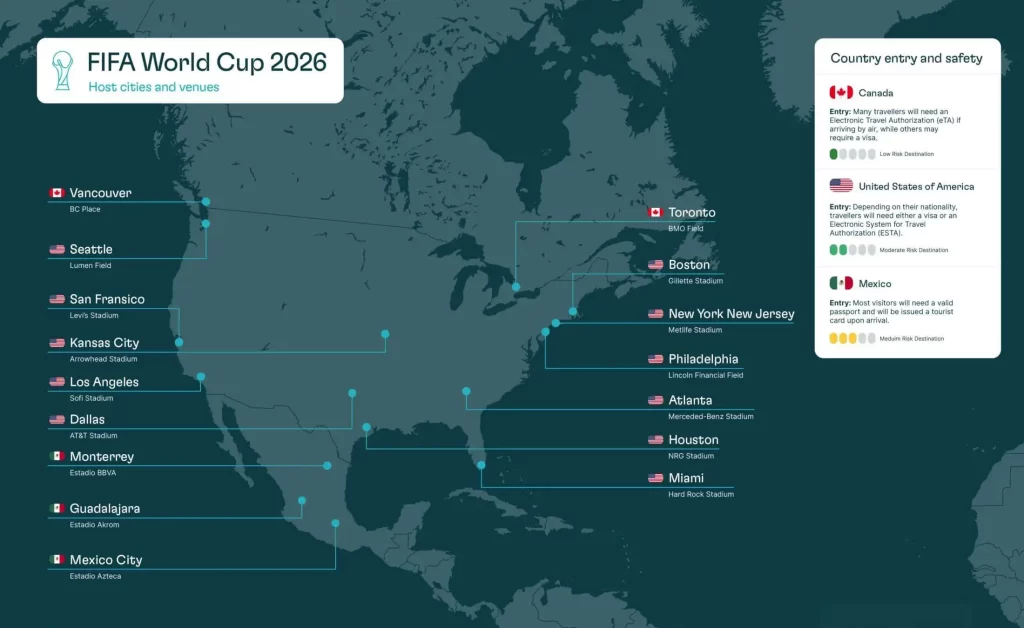
The 2026 World Cup host map is unusual by normal tournament standards. Instead of one host country, or even two, this event is being staged across three countries: Canada, Mexico, and the United States. FIFA’s official host cities overview confirms that these three nations are the hosts for the tournament, and the event spans 16 host cities in total. That scale changes how fans should think about location from the beginning. Official FIFA host cities overview
The biggest mistake some people make is treating all host cities as if they offer roughly the same experience. They do not. Some cities will feel like natural hubs for global visitors. Some will be easier to pair with multiple matches. Some may be better for fans who care about convenience. Others may appeal more to people who care about football culture, iconic venues, or host-nation atmosphere.
This is why city selection should not be the last thing you think about. For many fans, it should be one of the first things. Even before tickets are fully locked, a city strategy can help you decide which matches make sense, what level of flexibility you need, and whether your travel plan is realistic.
FIFA’s official match schedule and stadium information also reinforces this point. The tournament has 104 matches spread across the host map, so the city layer is directly tied to schedule density and practical planning. Official FIFA match schedule and stadiums
In other words, if you ignore the host city layer, you are not planning around the tournament properly. You are only planning around part of it.
Host cities in Canada
Canada has two host cities in the 2026 World Cup: Toronto and Vancouver. That smaller number makes Canada’s role feel more concentrated, but not less important. In fact, for many fans, that concentration can be helpful. Fewer host-city options can make planning more focused and easier to compare.
Toronto will naturally attract attention because it is one of the best-known international cities in the tournament. For fans who value familiar infrastructure, major-city scale, and a very global urban feel, it is an obvious city to watch closely. It is the kind of host city many international travelers will immediately understand.
Vancouver offers a very different flavor. It gives the tournament a western Canadian presence and changes the host map in a useful way for fans who think in broader travel routes. For some visitors, it may feel more attractive because it represents a different pace, setting, and tournament mood than the busiest east-side hubs.
The key point is that Canada’s role is not about quantity. It is about focus. For some fans, a concentrated host-country setup can be easier to plan around than a larger, more scattered map.
Host cities in Mexico
Mexico has three host cities for the 2026 World Cup: Mexico City, Guadalajara, and Monterrey. These three locations give Mexico a strong and very recognizable role in the tournament.
Mexico City stands out immediately because it is one of the biggest names on the entire host list. It carries obvious weight as a football city, and for many fans it will feel like one of the most iconic destinations in the tournament. It is also the kind of city that attracts attention even from neutral fans who simply want a memorable World Cup setting.
Guadalajara adds another major football center to the picture. For supporters who care about tradition, atmosphere, and a strong football identity, this is the kind of host city that naturally becomes part of the conversation early.
Monterrey gives the host map another important node in Mexico and broadens the country’s role beyond one headline location. That matters because tournament planning is rarely about one city alone. Fans often need alternatives, and multiple host cities inside the same host country can create more practical routes.
Together, these three cities make Mexico one of the most interesting host-country options for fans who want a mix of football energy, recognizable urban centers, and strong World Cup identity.
Host cities in the United States
The United States has the largest share of host cities in the tournament, with eleven locations: Atlanta, Boston, Dallas, Houston, Kansas City, Los Angeles, Miami, New York/New Jersey, Philadelphia, San Francisco Bay Area, and Seattle.
That large footprint means the U.S. side of the tournament will feel broad, varied, and highly flexible for different kinds of fans. Some of these cities are obvious global names that attract attention no matter what match is assigned to them. Others may appeal more to fans who value balance, local atmosphere, or a particular region of the host map.
For many supporters, the United States will offer the widest range of city strategies. If you want a major event feel, there are several cities that fit that profile immediately. If you care more about combining multiple fixtures, some locations may become more practical depending on the schedule. If you are trying to build a trip around convenience rather than prestige, the broader U.S. spread may give you more room to adapt.
That is the real advantage of the American side of the host map: flexibility. It does not automatically make every city easier or better, but it does give fans more ways to shape the type of tournament experience they want.
How to choose the right city as a fan
The right host city depends on what kind of fan you are. That is the simplest and most useful way to think about it.
If you are chasing a bucket-list World Cup memory, you will probably care about iconic venues, major-city atmosphere, and the chance of landing a high-profile match. In that case, your city shortlist will likely lean toward the most recognizable names in the host lineup.
If you care more about efficiency, your priorities should be different. You may want a city that helps you stay flexible, gives you realistic backup match options, and reduces the chance that your entire plan depends on one very hard ticket.
If you are the kind of fan who wants to attend more than one game, city strategy becomes even more important. You should think about whether your chosen host city gives you enough practical upside to justify building around it. Sometimes the best city is not the biggest city. Sometimes it is the one that makes your schedule easier to manage.
The smartest approach is usually not to choose a city based on hype alone. Choose it based on fit. Ask yourself what kind of trip you actually want, how flexible your budget is, and whether you want the “headline” experience or the “better value, less stress” experience. Those are not always the same thing.
Complete host city directory
Below is a clear directory of all 16 host cities, grouped by country. Use it as a quick reference when you compare tickets, match schedules, and travel plans.
Toronto
One of Canada’s two host cities. A natural option for fans who want a globally familiar big-city setting.
Vancouver
Canada’s western host city, useful for fans comparing different regional routes across the tournament.
Mexico City
One of the most iconic names in the host map and a city many fans will circle immediately.
Guadalajara
A major football city and an obvious point of interest for fans who value football culture.
Monterrey
Expands Mexico’s role in the tournament and offers another important city option inside the same host nation.
Atlanta
One of the U.S. host cities that adds depth to the tournament’s broader match map.
Boston
A recognizable host location that will appeal to fans comparing eastern options.
Dallas
A major host city in the U.S. portion of the tournament and a strong practical reference point.
Houston
Another major U.S. host city with a meaningful role in the match spread.
Kansas City
A host city that broadens the central portion of the U.S. tournament footprint.
Los Angeles
One of the highest-profile names in the host lineup and a natural point of interest for global fans.
Miami
A major host-city name that will likely appeal to fans thinking in atmosphere as well as match access.
New York/New Jersey
One of the biggest names in the tournament host map and a city pair many fans will prioritize.
Philadelphia
A strong eastern host-city option for fans comparing multiple U.S. locations.
San Francisco Bay Area
A distinctive host-region entry that stands out from single-city listings.
Seattle
A key western U.S. host city and part of the tournament’s wider regional spread.
Frequently asked questions
How many host cities are there in the 2026 World Cup?
There are 16 host cities across three countries. You can confirm the full host-city list through FIFA’s official host cities section. Official FIFA host cities page
Which countries are hosting the tournament?
Canada, Mexico, and the United States are the three host countries for the 2026 World Cup.
Should I choose a city before I choose a match?
In a tournament this large, it often helps to at least choose a shortlist of cities early. Your city plan affects your ticket strategy, your travel choices, and how flexible your backup options are.
What is the best city for first-time World Cup fans?
There is no one perfect answer. The best city depends on whether you care most about headline atmosphere, practical planning, multiple match options, or a more flexible trip overall.